AI Receptionist vs. Traditional Answering Service: Which Is Better for Small Businesses?
AI receptionist or answering service? Compare cost, coverage, and booking to see which fits your small business.
By Leonardo Camilleri
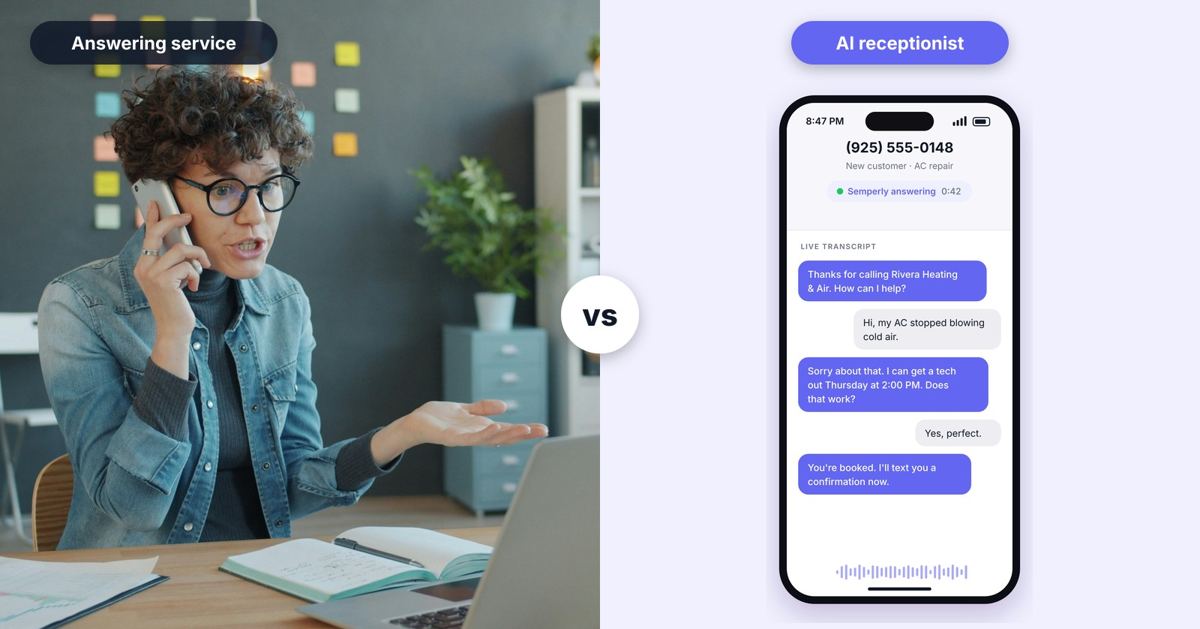
For most small businesses that need calls answered and appointments booked around the clock, an AI receptionist is the better fit. It answers every call, books jobs directly into your calendar, and usually costs less than a live answering service at the same call volume. A traditional answering service can still be a good choice when most calls require human judgment or your customers expect to speak with a person every time.
Missed calls can have a significant impact. According to Semperly, 62% of inbound calls to small businesses go unanswered after hours or while the team is busy, and missed calls cost a busy home-service business an average of $41,600 a year.
Here's how the two options compare on cost, coverage, and what happens when your phone rings.
What Is a Traditional Answering Service?
A traditional answering service uses a team of live operators to answer calls when you can't. They greet callers with your business name, take messages, and, depending on the plan, transfer calls or handle simple scheduling.
Most services bill by the minute or by the call. Ruby, one of the best-known providers, publishes plans ranging from $250 a month for 50 receptionist minutes to $1,725 a month for 500 minutes. Across the industry, per-minute rates for human operators typically range from $0.75 to $1.50, and many services charge 20% to 50% more for calls handled in the evenings and on weekends.
What Is an AI Receptionist?
An AI receptionist is software that answers your phone with a natural-sounding voice. It learns about your business, including your services, prices, hours, and FAQs, and handles calls independently, day or night.
The best AI receptionists do more than take messages. They qualify callers, check current availability, book appointments during the call, text customers a confirmation, and record the details in your CRM. When a call requires a person, they transfer it. In our demo, Semperly's AI receptionist books a same-week HVAC appointment in under 30 seconds.
Side-by-Side Comparison
| Feature | Traditional answering service | AI receptionist |
|---|---|---|
| Availability | 24/7 on most plans, often with after-hours surcharges | 24/7, including nights, weekends, and holidays |
| Busy periods | Depends on how many operators are available | Answers every call, even when several come in at once |
| Booking | Usually takes a message; booking depends on the plan and setup | Books the appointment during the call |
| Knowledge of your business | Follows a script you provide | Learns your services, prices, hours, and FAQs |
| Pricing model | Per minute or per call, plus overages | Typically a flat monthly plan |
| Cost in a busy month | Increases with each minute used | Remains predictable |
| Call records | Messages and call notes | Transcripts, summaries, and leads synced to your CRM |
| Human judgment | Well suited to sensitive or complex calls | Transfers urgent or complex calls to your team |
What the Cost Difference Looks Like
Consider a business that receives about 100 calls a month, averaging three minutes each. That adds up to roughly 300 minutes.
- Traditional answering service: At typical rates of $0.75 to $1.50 a minute, that's $225 to $450 a month before after-hours surcharges or overages. On Ruby's published plans, 300 minutes falls between the 200-minute plan ($720) and the 500-minute plan ($1,725).
- AI receptionist: Industry pricing for AI plans at small-business call volumes typically ranges from $50 to $250 a month.
It's also worth reviewing two potential costs before choosing a service. Some per-minute services count spam and wrong-number calls toward your minutes. Your busiest months, when answering calls matters most, can also bring the highest per-minute bills.
Want to see how the numbers work for your business? Talk to sales.
When a Traditional Answering Service Is the Better Choice
- Your calls require human judgment. Legal intake, sensitive medical questions, and emotionally difficult conversations can benefit from a trained person.
- You receive a few calls and mainly need messages. If you simply need someone to greet callers with your business name and collect a phone number, a small live answering plan can work well.
- Your customers expect to speak with a person. Some clients prefer a human voice and may hang up if they don't reach one.
When an AI Receptionist Is the Better Choice
- Your calls lead to appointments. If most callers want to book a service visit, consultation, or estimate, an AI receptionist books the appointment during the call instead of passing along a message.
- After-hours calls matter. Emergencies, evening inquiries, and weekend leads receive an immediate response instead of waiting until the next morning.
- Your call volume spikes. A heat wave, storm, or busy season can bring a sudden increase in calls. AI answers simultaneous calls without a hold queue.
- You want organized call data. Every call becomes a transcript, summary, and lead in your CRM, keeping the information recorded rather than scattered across handwritten notes.
The Best of Both: AI First, Humans When It Counts
You can combine AI coverage with human support. Many small businesses use AI to answer routine calls and book appointments, then transfer emergencies and complex requests directly to the owner or an on-call technician.
This gives you 24/7 coverage at a predictable cost while maintaining personal support for calls that need it. That's how Semperly works: our AI receptionist answers routine calls and books appointments, while emergencies and complex calls go directly to your team.
What to Look for in an AI Receptionist
AI receptionists offer different capabilities. Before choosing one, make sure it can:
- Book appointments during the call, beyond simply taking a message.
- Connect to your CRM so every call becomes a lead.
- Transfer emergencies to a person immediately.
- Learn about your business, including your services, prices, hours, and FAQs, without requiring a lengthy script.
- Be set up in minutes rather than weeks.
- Handle additional tasks, such as customer email and scheduling.
Semperly does all six. We built it specifically for home-service businesses, so it books appointments in the calendar you already use, records leads in Jobber and Housecall Pro, and routes urgent calls to your on-call technician.
How Semperly Fits
Semperly is an AI automation platform for home-service businesses, including HVAC, plumbing, electrical, roofing, and cleaning companies. Our AI receptionist answers every call, 24/7, qualifies the job, books it in the calendar you already use, texts the customer a confirmation, and records the lead in tools such as Jobber and Housecall Pro. Urgent calls go directly to your team.
It works alongside the rest of our platform, including AI Inbox for customer email, scheduling, and CRM automation. Setup takes about 10 minutes: enter your website, and Semperly learns about your business.
Frequently Asked Questions
Is an AI receptionist cheaper than an answering service?
Usually, yes. Traditional services bill by the minute or call, so costs rise with volume. AI receptionists typically charge a flat monthly fee, which tends to cost less at small-business call volumes.
Can an AI receptionist book appointments?
Yes. A full-featured AI receptionist checks current availability, books the appointment during the call, and then sends the customer a confirmation.
Can an AI receptionist transfer calls to a real person?
Yes. You can set rules so emergencies and complex calls go directly to you or your on-call team.
Is an AI receptionist available after hours?
Yes. It answers 24/7, including nights, weekends, and holidays, usually with no additional charge for after-hours calls.
Which is better for a small business?
For most small businesses, especially home-service businesses whose calls lead to appointments, an AI receptionist is the better choice. Semperly combines both approaches: our AI answers routine calls and books appointments 24/7, while emergencies go directly to your team. If nearly all your calls require sensitive human judgment, a traditional answering service may still be a good fit.